

Only female mosquitoes bite
Only female mosquitoes bite. Female mosquitoes need blood in order to produce eggs.
Learn more at https://www.cdc.gov/mosquitoes/about/index.html

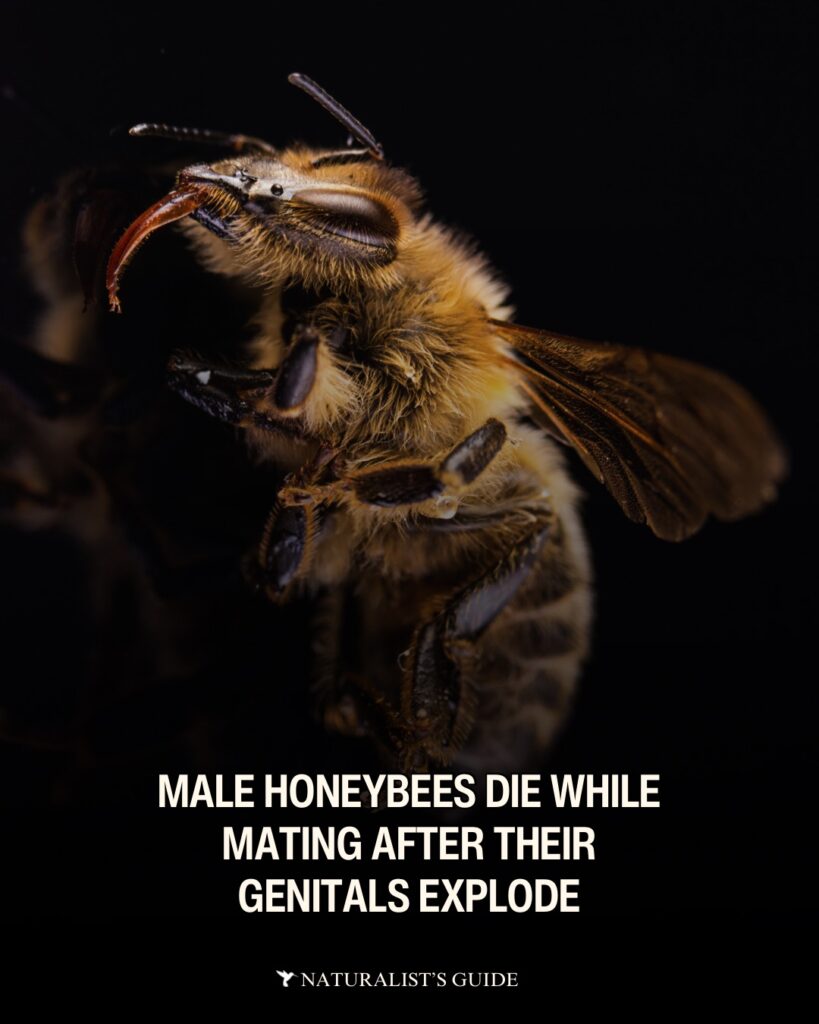
Male honeybees die after sex because their genitals explode
Male honeybees die after mating because their genitals explode. This leaves their genitals inside the queen which blocks further insemination by other bees.
Learn more at https://www.orkin.com/pests/stinging-pests/bees/honey-bees/mechanics-of-honey-bee-mating
Male bedbugs have sharp penises to stab females in the abdomen
Male bedbugs have sharp penises that stab females in the abdomen to release sperm into the female’s circulatory system.
Learn more at https://www.science.org/content/article/bedbugs-extraordinary-penis

Butterflies Taste with Their Feet
Many butterflies have chemoreceptors on their feet that let them “taste” the plants they land on.
Learn more at https://www.floridamuseum.ufl.edu/exhibits/blog/butterfly-moment-how-do-they-taste/

Mealworms are plastivores and have the ability to breakdown plastic
Mealworms are plastivores and have the ability to breakdown various plastics in only a few hours. Plastivores are bacteria, fungi, and insects that can safely degrade and metabolize plastic. According to researchers, it would take about one million billion mealworms to eat one day’s worth of our global plastic production.
Learn more at https://naturalistsguide.com/mealworms-can-safely-eat-styrofoam-and-break-it-down-into-carbon-dioxide-and-degraded-particles/

The buzz of a cicada can reach up to 106.7 decibels—comparable to heavy machinery
The noise a cicada makes can reach a volume up to 106.7 decibels—comparable to heavy machinery. They use this noise to help attract mates. The cicadas emerge only to mate and breed before their deaths.
Learn more at https://blogs.cdc.gov/niosh-science-blog/2021/07/20/noise-myths-cicada/

You can tell temperature by counting the number of cricket chirps in 15 seconds and adding 40 to get the temperature in Fahrenheit (F)
Called Dolbear’s Law, the temperature in degrees Fahrenheit can be approximated by counting the number of cricket chirps in 15 seconds and adding 40. That will give you the temperature in Fahrenheit (F). Therefore: Temperature (F) = number of cricket chirps in 15 seconds + 40
Learn more at https://naturalistsguide.com/how-to-tell-temperature-based-on-cricket-chirps/

Not all fireflies glows—instead they give gifts to attract mates
Some species of firefly don’t glow at all. Males of the firefly species, Ellychnia corrusca, don’t have a lantern. Instead, they give gifts to attract females.
Learn more at https://www.firefly.org/types-of-fireflies.html

Spiders can’t close their eyes because they don’t have eyelids
Spiders and insects can’t close their eyes because they don’t have eyelids. They are able to sleep by putting their body in a rest state.
Learn more at https://www.tepapa.govt.nz/discover-collections/read-watch-play/science-and-nature/spiders-and-insects/your-bug-questions/do

Some ticks can live up to two years without a host body.
Some ticks can live up to two years without a host body. Some ticks will attach quickly and others will wander, looking for places like the ear, or other areas where the skin is thinner to attach. You never know how or when ticks may attach themselves.
Learn more at https://naturalistsguide.com/tick-safety/

Any handful of soil or water will likely contain thousands of microscopic worms
Any handful of soil or water will likely contain thousands of microscopic worms called nematodes.Nematodes are one of the most abundant multicellular organisms on Earth.
Learn more at https://www.sciencedirect.com/science/article/abs/pii/0043135479900095


